A 41mm watch can be a candidate for a 6.5-inch wrist, but those two numbers cannot establish whether it will fit comfortably or look the way you want. Before buying, check the case’s lug-to-lug length, any rigid bracelet section beyond the lugs, and whether the fitted strap or bracelet can adjust to you. Compare those details with a watch you already like wearing.
A 6.5-inch wrist circumference is 165.1 mm, or about 16.5 cm. That measures the distance around your wrist. It does not tell you the width or shape of the area supporting the watch, and it does not set a universal maximum case diameter.
What the 41mm measurement leaves out
Case diameter describes one dimension of the watch body. It does not describe the full span from the upper lug tips to the lower lug tips, where the bracelet begins to bend, or how long the strap can be when fastened. Check how the maker defines its diameter rather than substituting a bezel measurement or a measurement including the crown.
NOMOS’s dress-watch guide explicitly advises considering lug-to-lug distance as well as diameter. Its styling preferences are not a universal fit rule, and this guide does not turn them into a millimeter cutoff for every 6.5-inch wrist.
Get these details for the exact configuration
| Detail to request | What it helps you judge | What to ask for |
|---|---|---|
| Case lug-to-lug length | How far the fixed case extends along the strap direction. | A specification or measurement with the endpoints identified. |
| Rigid end links and first links | Whether the bracelet extends the fixed footprint before it can turn downward. | Side views of both ends, showing the first freely moving joint. |
| Case thickness and lug profile | How high the watch sits and how its shape approaches the wrist. | A side view and a thickness measurement with its scope stated. |
| Bracelet sizing options | Whether this bracelet can reach a useful length around your wrist. | Removable links, smaller sizing options and the exact clasp adjustment arrangement. |
| Strap lengths and usable holes | Whether the supplied strap can fasten at a suitable position. | Long/short lengths, buckle or clasp type, and the maker’s sizing guidance for that combination. |
| Clasp shape and position | Whether the folding section has room to sit comfortably underneath. | A view of the open clasp and its position when fastened. |
| Included parts and return conditions | What you can change, and when to decide about keeping the watch. | Included spare links, confirmed alternatives, and conditions that apply before resizing. |
A “fits up to” statement gives a maximum under the seller’s stated conditions. Ask about the minimum usable fit too, and whether the claim includes extra links or a different strap. Do not treat a closed bracelet’s measured length as an automatic wrist-fit guarantee. If taking out one link leaves the bracelet tight and putting it back leaves it loose, see what to check between bracelet link sizes.
Look at where the bracelet starts to bend
The relevant question is not simply whether an end link is solid. It is whether any section projects beyond the lug tips and remains rigid before the bracelet can turn down around your wrist. A solid end link can still have a joint positioned close to the case.
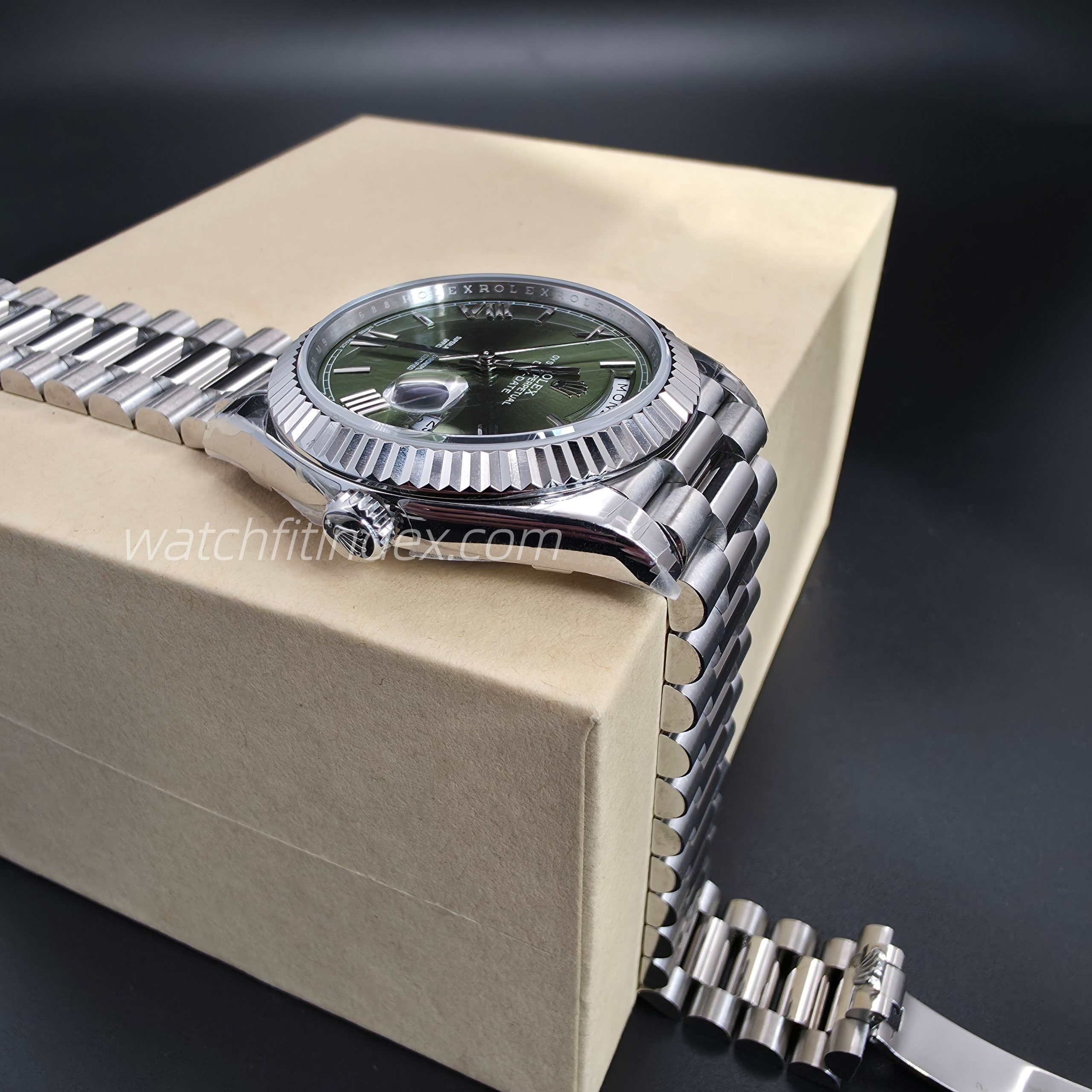
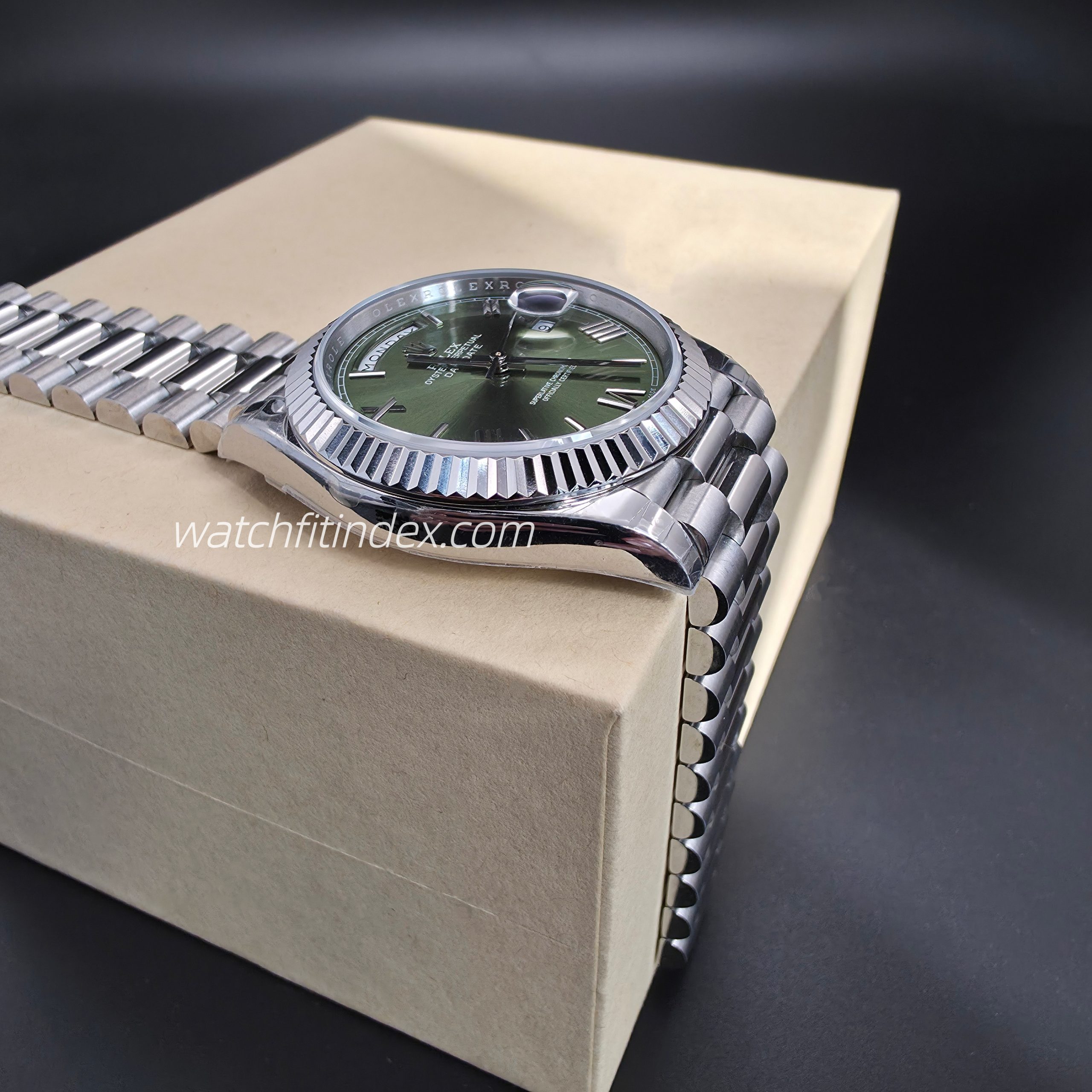
Ask for a side view with the bracelet hanging naturally, without being forced into a curve. Identify the fixed case, any projecting rigid section and the first moving joint at each end. If a seller gives an “effective lug-to-lug” figure, ask them to identify its endpoints; the term alone does not establish a consistent measurement method.
This is a structural check, not a measurement supplied for a particular 41mm watch. Curved lugs and the height at which the bracelet articulates can also affect how the assembly sits. A photograph can help explain the connection, but it cannot establish how that watch will feel on your wrist.
Follow the bracelet from the lug tip to the edge of the box in these two views of a VSF Day-Date 228239-0033 replica. Looking at both ends helps you see where the links start to turn down.
Compare with a watch that already works for you
- Measure your wrist where you normally wear the watch. Use a flexible tape, or mark a non-stretch strip and measure it flat. Keep the unit with the measurement.
- Record your current watch’s dimensions. Use the same definitions for case diameter, case lug-to-lug and thickness. Note any rigid bracelet projection separately.
- Compare the whole assembly. A candidate with a similar case span may still behave differently if its bracelet starts bending farther from the case or its clasp is longer.
- Try the candidate if possible. Check the lug ends, the bracelet’s turn around the wrist and the clasp underneath. Assess the appearance in a mirror as well as from directly above.
Two wrists with the same circumference can have different shapes. Do not divide the circumference by pi and treat the result as your actual wrist width: that assumes a circular cross-section. A comparison with your own comfortably fitting watch is more informative than assigning everyone with the same circumference a single diameter limit.
A short strap solves a different part of the fit
If the supplied strap is too long to fasten where you need it, a compatible shorter strap may address that length problem. It does not shorten the metal case or its lugs. First establish whether the obstacle is the fastening length, the fixed watch footprint, or both.
NOMOS lists strap lengths as separate long and short sections, excluding clasps. Delugs also distinguishes the long section, short section and hole spacing. Those details matter more than an unsupported “small” or “medium” label. A strap’s width is a separate connection measurement; the right width alone does not settle every compatibility question.
Crown & Buckle’s sizing guidance notes that a strap’s usable fit depends on the watch, lug shape, strap thickness and preferred tightness. Use a supplier’s wrist range with its stated assumptions, not as a promise for every watch that can take the same nominal strap width.
Make a purchase decision from the missing detail
- Keep it on the shortlist when its fixed span is comparable to a watch you wear comfortably and the exact strap or bracelet has a confirmed sizing option for you. This supports trying it; it is not a comfort guarantee.
- Request more information when the listing provides only diameter, a maximum wrist size or a photograph of a different bracelet version. Ask for the specific missing measurement or view.
- Consider another configuration or watch when the available strap cannot fasten suitably, the rigid span conflicts with the fit you want, or compatibility cannot be established. Identify which problem the alternative actually changes.
If the watch is a VSF replica, request information for the replica and its fitted bracelet. Genuine-model dimensions, original-brand clasp specifications and wrist photos of a different version do not verify the item being offered.
A buying enquiry for a 6.5-inch wrist
“My wrist measures 6.5 inches (about 165 mm) where I wear my watch. For this exact watch and bracelet/strap version, could you confirm the case lug-to-lug length, show where the bracelet first bends down, and explain the minimum sizing options and clasp adjustment? Please also confirm the supplied links or strap lengths and the return conditions before any resizing.”
Sources and scope
Sources checked on November 3, 2026. The owner supplied the two photographs and identified the sample as a VSF Day-Date 228239-0033 replica. The photographs illustrate the bracelet connection. No case diameter, lug-to-lug measurement or 6.5-inch wrist trial was recorded for this sample. The measurement comparison and decision sequence are editorial guidance, not a manufacturer-approved sizing formula.
Leave a Reply