If removing one bracelet link makes your watch too tight, but adding it back makes it too loose, check for a smaller adjustment on your exact bracelet and clasp. That might be a clasp setting or a compatible half link. A fold-out extension may provide another length, but it is not automatically a fine-adjustment system. Start with the parts you have before buying replacements.
This is a guide to choosing the next check, not a universal resizing procedure. The available options depend on the bracelet, clasp and version fitted to your watch.
First, identify the bracelet and clasp you actually have
A watch reference alone may not identify its current bracelet. A used watch may have replacement parts, and a familiar-looking clasp does not establish its adjustment features. Find the bracelet or clasp reference where available, then compare it with the matching manufacturer instructions.
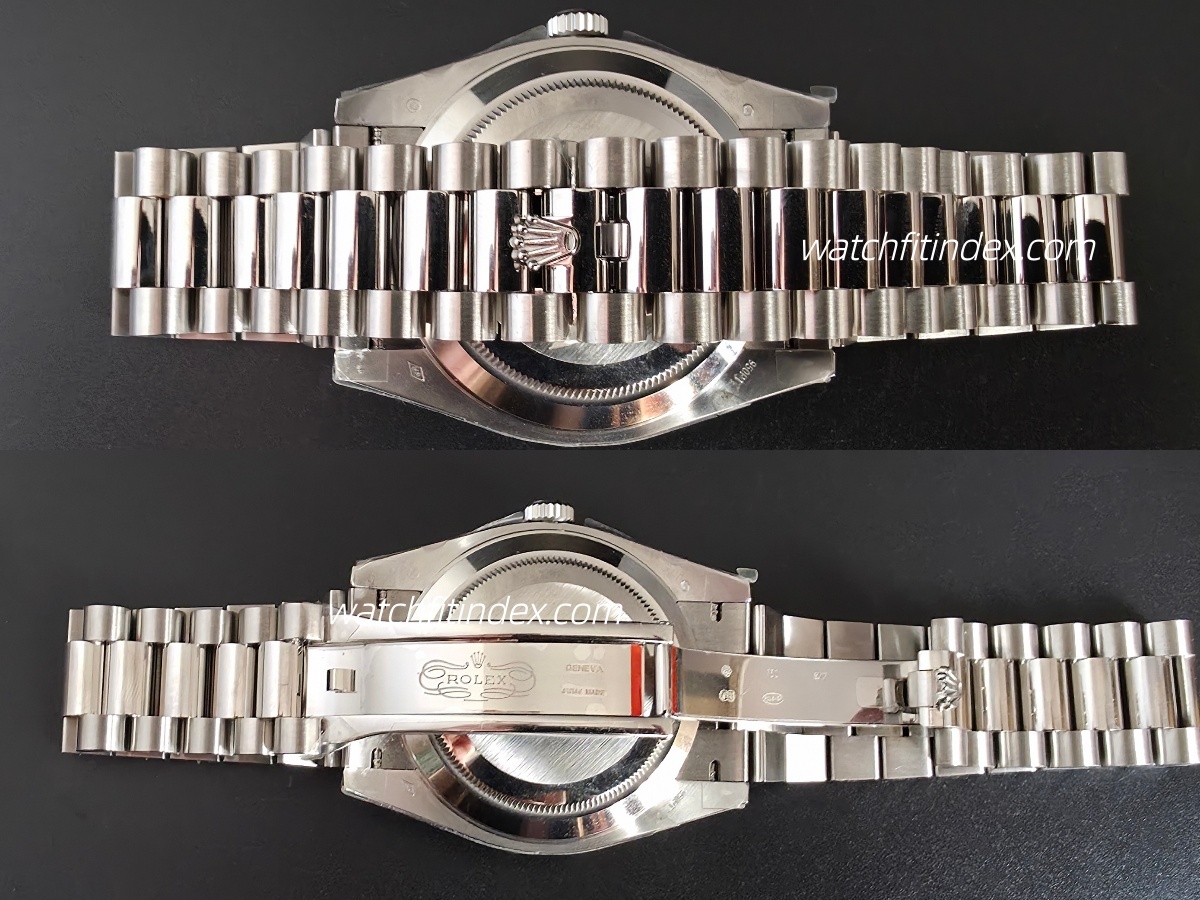
- Photograph the watch with the complete bracelet, the outside of the closed clasp, and the inside of the open clasp.
- Record the current clasp setting and whether any extension is folded or extended, if you can identify it from the instructions.
- Keep the removed links and their fastening parts together. Record which side they came from if that is known.
- Describe the problem precisely: the whole bracelet is too tight, the watch slides, or one part of the clasp presses awkwardly.
If the mechanism is unfamiliar, send those details to the manufacturer, seller or a watchmaker before trying to move it. This avoids treating a hinge or release catch as a sizing control.
Which option could bridge the gap between full links?
| Option | What it changes | What to confirm first |
|---|---|---|
| Full link | The assembled bracelet length by one link increment. | Which links are removable and the permitted fastening method. |
| Compatible half link | A smaller sizing increment on a bracelet designed to accept it. | Exact bracelet/version compatibility, fitting position and required hardware. |
| Clasp adjustment | The effective bracelet length at the clasp, where adjustment is provided. | Available settings, the current setting and the correct procedure. |
| Fold-out extension | An additional length when its extension is opened. | Whether it offers the length you need; do not assume intermediate positions. |
| Replacement clasp or strap | The available length or adjustment arrangement, if the replacement fits. | Connection geometry, hardware, usable length and compatibility with this watch. |
Use this as a list of possibilities, not a claim that every bracelet offers all five. The word “half” is also not a substitute for a published dimension: ask what length change the specific part provides.
Micro-adjustment and extension are different questions
Check whether your clasp offers several length settings, a fold-out section, both, or neither. Then check how its maker says that mechanism is operated. Some settings require a tool; others are designed for tool-free use. Do not infer the procedure from appearance alone.
For a documented example, Rolex specifies an Easylink extension of approximately 5 mm on the genuine Air-King 126900. Its Explorer user guide (pages 12–13) shows the Easylink link folded or extended. That describes a change between lengths, not a promise of every intermediate setting.
By comparison, Rolex describes Glidelock on the genuine Submariner Date 126610LN as providing tool-free fine adjustment. Use the instructions for the relevant model and version to establish its settings and range; do not transfer specifications between different clasps.
These Rolex examples describe genuine Rolex products. They do not verify the mechanism, adjustment range or parts compatibility of a VSF replica or another replacement bracelet. Those require evidence for the actual item.
Check remaining movement, not just the advertised range
A clasp’s total travel is the distance between its shortest and longest settings. The adjustment still available depends on where it is set now. A clasp already at its longest setting cannot add more length through that adjustment.
For illustration only: if an adjustment runs from 0 to 10 mm and is currently at 8 mm, it has 2 mm left in the longer direction and 8 mm toward the shorter setting. These are hypothetical numbers, not specifications for a watch.
This is why a fitter may assess the combination of full links and clasp settings. An additional link combined with a shorter clasp setting could provide a useful intermediate fit, but only if the actual increments and range allow it. A range listed online does not tell you whether that combination exists on your bracelet.
A half link is an option only when the part is confirmed
Tusenö’s half-link guide gives a concrete example: it describes using a half link when full-link changes do not achieve the desired fit on the specified Windseeker and Shellback flat-top bracelets. It also identifies a particular fitting position. That is evidence for those bracelets, not a universal installation method.
Before ordering a half link, ask for confirmation of your bracelet reference, version, connection shape, fastening parts and intended installation position. A matching width or similar finish is not enough to establish compatibility. If no compatible part is confirmed, keep it off the solution list.
If the length seems right but the clasp feels wrong
Show a fitter where the clasp presses and how the bracelet sits beneath your wrist. Ask them to assess the distribution of links on each side and the position of the inner folding blade as well as the outer clasp cover. Moving an existing link from one side to the other redistributes length; it does not add or remove that link’s length from the bracelet overall.
There is no reason to assume that equal link counts on both sides will suit every clasp and wrist. Make one documented change at a time, following the correct procedure, and check the result before making another.
The next steps, in order
- Identify the current parts. Obtain the matching instructions or ask for identification using clear photographs.
- Record the present setting. Check whether usable adjustment remains in the direction you need.
- Assess the existing combinations. Ask a fitter whether the full-link count and available clasp settings can bridge the gap.
- Confirm a smaller part if needed. Check the exact half link or replacement option before ordering.
- Recheck the whole fit. Assess clasp placement as well as looseness, and retain removed parts and the record of the final setting.
For a newly delivered watch, check the seller’s return conditions before resizing or disassembling the bracelet. If there is no verified intermediate setting or compatible part, a different compatible strap or bracelet may be worth considering. More tightening will not create an adjustment the mechanism does not have.
A message you can send with your photos
“Removing one full link makes this bracelet too tight; adding it back makes it too loose. Could you identify the bracelet and clasp version, confirm the current setting and remaining adjustment, and tell me whether a compatible half link or another approved configuration is available? Please confirm the exact part and installation requirements before I order.”
Sources and scope
Manufacturer sources checked on November 3, 2026. The photograph was supplied by the site owner, who identified the sample as a VSF Day-Date replica. It illustrates visible clasp construction; no adjustment-range measurement, compatibility test or wrist-fit trial is reported.
Leave a Reply